Minneapolis Street Tree Planting Guidelines to Increase Diversity
Abstract
The threat and eventual loss of ash trees (Fraxinus) to emerald ash borer (Agrilus planipennis) in Minneapolis, MN, USA, was a major opportunity to establish a more diverse and resilient public street tree population. This generational opportunity was embraced. With the goal of increasing urban forest resiliency against future pests and conditions, Minneapolis developed and applied multiscaled tree selection guidelines to systematically select and plant a diverse mix of trees. Within a relatively short amount of urban forest time, the diversity of the Minneapolis public street tree population greatly increased. Within the past two decades, the number of genera that make up 1% or more of the public street tree population has nearly doubled. Before the guidelines, maple (Acer) comprised 30% of the public street tree population. Currently, there are no genera that comprise 20% or more of the public street tree population in Minneapolis. As a result of the guidelines, there is more diversity across the whole city, within neighborhoods, and along individual street block segments. The benefits of this diversification will hopefully lessen the exposure to and impact of future urban forest pests and other challenging conditions.
The myriads of benefits from urban trees have been well documented (Tyrväinen et al. 2005; Turner-Skoff and Cavender 2019). Cost benefit analysis (Song et al. 2018) and the need for targeted site design have also been shared (Pataki et al. 2021). Concerns have been raised about the potential insect and disease impact from exotic pests to the Minneapolis urban forest (Nowak et al. 2006). The potential costs and budgetary impacts of emerald ash borer (Agrilus planipennis) have been estimated (Kovacs et al. 2010; Hauer and Peterson 2017). Management challenges, tactics, and options to address emerald ash borer infestation have also been investigated (McKenney and Pedlar 2012; Flower et al. 2015; McCullough 2020). The often referred to ‘rule of thumb’ urban forest diversity guidance credited to Frank S. Santamour, Jr. recommends having no more than 10% of a single species, 20% of a genus, and 30% of a family (Santamour 1990). Implementation of this 10/20/30 rule has been credited with increasing diversity for the sake of resilience across urban forests and has also been a topic of discussion and analysis (Kendal et al. 2014). A stringent 5% limit of a genus has more recently been proposed to reduce the impact of urban forest threats (Ball 2015). In the face of the impending impact of emerald ash borer to the urban forest, Minneapolis developed and implemented public street tree diversity guidelines to increase resilience to future threats at the city, neighborhood, and street block segment scales.
Similar to many cities across the Eastern United States prior to 1970, Minneapolis’ street tree population was primarily comprised of elm (Ulmus). Following significant public street tree losses resulting from Dutch elm disease (caused by Ophiostoma novoulmi), Minneapolis engaged community groups across the city and developed the “Minneapolis Neighborhood Boulevard Reforestation Plan” in 1978 (Sand et al. 1978). The plan assigned a tree species to every street segment across Minneapolis on a block-by-block basis. The plan was organized by neighborhood. There are currently 87 neighborhoods across Minneapolis. This plan aimed to make a tenfold increase in the diversity of the Minneapolis public street tree population (Figure 1).
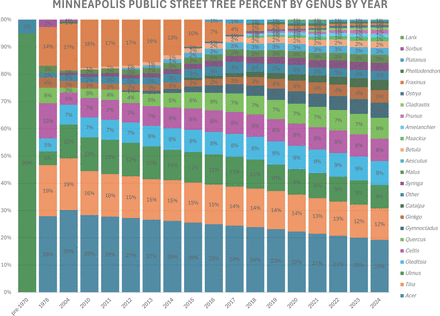
Figure 1.
Chart of Minneapolis public street tree percent by genus over multiple years. Pre-1970 was reported in the “Minneapolis Neighborhood Boulevard Reforestation Plan” (Sand et al. 1978). The 1978 data was the intended population from the “Minneapolis Neighborhood Boulevard Reforestation Plan.” The 2004 data is from an i-Tree analysis. The data from 2010 to 2024 is from the Minneapolis Park & Recreation Board public tree inventory system.
Data was collected in 2004 for a sampling study of the Minneapolis public street tree population using protocols for STRATUM (Street Tree Resource Analysis Tool for Urban Forest Managers), which eventually became i-Tree Streets (McPherson et al. 2005). Results from this USDA Forest Service analysis confirm that the reforestation plan from 1978 had been successfully realized by 2004 (Figure 1). In terms of susceptibility of the Minneapolis public street tree population to a single urban forest pest, the 2004 forest was in much better shape than the forest pre-1970. When Dutch elm disease arrived in Minneapolis in the 1960s and 1970s, over 90% of the public street tree population was susceptible to the devastating disease. By 2004, only 17% of the public street tree population was susceptible to the soon to arrive emerald ash borer. Although a potential 17% city scale loss was a much more operationally achievable outlook, a full street block of all susceptible trees was still daunting and alarming from the perspective of an individual property. Emerald ash borer was confirmed in Minneapolis in 2010. By this time, Minneapolis had also completed a tree inventory census of public trees and started using an online tree inventory system. Tree inventory census data from 2010 was very similar to the sampled results from the 2004 analysis, with ash comprising 18% of the public street tree population (Figure 1).
Many cities in North America have been impacted by emerald ash borer with each city striving to provide the best preparation and care for the forests in communities they serve. There were cities that were unfortunately taken by surprise close to “ground zero.” Many communities formed plans to treat a subset of their public ash trees to “buy time” while gradually replacing nontreated ash trees. Other cities launched plans to treat all their public ash trees through routine maintenance investments to perpetuate tree benefits as long as possible. At the same time, cities like Minneapolis enacted plans to gradually and systematically replace public ash trees while allowing individuals, block clubs, and neighborhood organizations to treat ash trees in alignment with their local goals and budgets. The Ash Canopy Replacement Plan in Minneapolis was formed following many considerations and stakeholder engagement, including: assessment of the level of infestation; the perceived rate of spread; long-term maintenance costs; scenario analysis; community pesticide concerns; neighborhood engagement; elected official input; advisory commission involvement; research partnership; and agency consultation.
In 2014, the Minneapolis Park & Recreation Board launched a plan to systematically replace 40,000 public ash trees (30,000 street trees and 10,000 park trees) over an 8-year period. Emerald ash borer infested trees were removed and replaced as the highest priority. Proactively nonsymptomatic public ash trees were also gradually replaced. This was facilitated by selecting a small number of ash trees from each block and park across the city to be replaced over all 8 years of the plan. Said another way, full street block segments of nonsymptomatic ash trees were not removed at the same time.
Public trees in Minneapolis are selected and planted by Minneapolis Park & Recreation Board staff arborists and foresters. From 2004 to 2013, Minneapolis planted an average of about 4,500 public trees annually. Trees were purchased with general operating funds from property taxes. From 2014 to 2022, Minneapolis planted an average of about 9,000 public trees annually. The annual cost to purchase trees was about $1 million. Additional funds, beyond general operating funds, were secured via a Tree Preservation and Reforestation Levy which enabled the Minneapolis Park & Recreation Board to facilitate its Ash Canopy Replacement Plan. Besides removing ash trees, the plan doubled Minneapolis’s planting capacity. Since 2022, Minneapolis has been planting more than 9,000 trees per year; however, the Tree Preservation and Reforestation Levy has not continued as a funding source. Finding the balance of funds to maintain this level of public tree planting has become challenging and less certain. In 2023 and 2024, instead of coming from the Tree Preservation and Reforestation Levy, half of Minneapolis’s tree purchase funds came from the American Rescue Plan Act, a federal economic stimulus bill passed in 2021 to aid in the recovery from the COVID-19 pandemic. In 2025, with still only half of the needed funds coming from general operating funds, the other half of the tree purchase budget is coming from a combination of two grants, a philanthropic gift, and revenue from the sale of carbon credits. Since 2021, Minneapolis has annually registered tree planting carbon offset projects with the national nonprofit carbon registry and certification organization, City Forest Credits, via a public-private partnership with the project operator, Green Cities Accord, to help fund future tree planting and maintenance.
In Minneapolis, public tree planting stock is sourced through an annual bid process where each variation in cultivar, root type, and size is individually bid. For the past decade, there have been approximately 200 individually bid line items on the annual bid document. Minneapolis purchases trees from about a dozen different nursey vendors to achieve the desired quantity in each category. Minneapolis has not utilized contract growing as a means to acquire a desired level of diversification. Thus far, Minneapolis has been utilizing the annual bid listing to describe and signal to growers what the public tree planting needs are in Minneapolis. In addition, the Minneapolis Park & Recreation Board has a strong long-term research and outreach partnership with the University of Minnesota to trial cultivars, stock types, planting methods, and climatic shifts before transitioning into full production.
In the lead up to the ash tree replacement plan, public street tree selection guidelines were developed to increase diversity within a street block and at the neighborhood scale. These guidelines are applied by referencing tree inventory data at multiple scales (city, neighborhood, and street block segment). Species selection is essentially limited based on the existing genera level diversity that exists at each scale.
Starting at the neighborhood scale, the guideline restricts the planting of any genus that comprises 10% or more of the neighborhood public street tree population. As an example, if there is already 12% linden (Tilia) within a neighborhood, then linden is restricted from being planted in that neighborhood. Dynamic reports are generated within Minneapolis’s tree inventory system to guide arborists and foresters on which genera are overrepresented.
There are two guidelines that further restrict tree selection at the street block scale. Tree selections are restricted along a street block segment from any genus that comprises 5 or more trees from a given genus. As an example, if there are already 2 bicolor oaks (Quercus bicolor) and 3 northern pin oaks (Quercus ellipsoidalis) on a block, all oaks (Quercus) are restricted from being planted along that street block segment.
The other street block scale guideline is aimed at achieving resiliency to a potential future infestation from Asian long-horned beetle (Anoplophora glabripennis). Public street tree selections of Asian long-horned beetle preferred host genera include: maple (Acer), buckeye (Aesculus), birch (Betula) and elm (Ulmus). These are restricted if there are already a combined 5 trees from any of those preferred host genera along a block segment. As an example, if there are already 4 maples and 1 elm along a street block segment, then maple and elm along with birch and buckeye are all restricted from being planted on that street block segment.
Guideline compliance and quality control has been annually assessed to ensure compliance and to determine ongoing arborist and forester training needs and improvements. The guidelines have also been incorporated into Minneapolis standard specification documents to ensure contractors, consultants, and City Divisions comply with the guidelines when planning and building public infrastructure projects within the urban forest.
The Minneapolis public street tree selection guidelines applied at the neighborhood and block scales have increased diversity at the city scale (Figure 1). In 2010, 11 genera made up 1% or more of the public street tree population with 4 genera each comprising more than 10% of the population (maple 28%, ash 18%, linden 16%, elm 12%), combined representing 74% of the population. In 2024, 21 genera made up 1% or more of the public street tree population with only 2 genera each comprising more than 10% of the population (maple 19%, linden 12%), combined representing only 31% of the population. In 2024, no genera made up over 20% of the public street tree population in Minneapolis.
The Minneapolis urban forest is more diverse and more resilient to future pests and conditions as a result of utilizing neighborhood and street block scale tree selection guidelines.
Cities interested in increasing public urban forest street tree diversity could apply the same or similar neighborhood and block scale guidelines to achieve similar increases in diversity. The guidelines could be used as is or further honed to meet a given community’s needs. One way to improve or further customize the guidelines would be to choose an amount more specific than limiting to 10% of a genus by neighborhood. Said another way, the neighborhood guideline or limit could be set individually by genus. For example, instead of limiting all genera to 10% at the neighborhood scale, a community may choose to limit Catalpa to 8% and Malus to 5%, or to limit Quercus to 11%. A community could also choose to set some species or species group limits instead of stopping at genus. As an example, a community could limit red oak group Quercus with a different limit than white oak group Quercus from a need or concern related to the rate of spread of oak wilt (Bretziella fagacearum). Further customizing the block scale guidelines could also be considered to best fit another city.
Neighborhood and street block segment have been meaningful and intuitive scales for applying the guidelines in Minneapolis, however other scales and geographies could also be considered. One problem with a political boundary such as neighborhood is that it could still allow for overpopulation within a vicinity where neighborhood boundaries meet. For instance, Tilia may be overrepresented in an adjacent neighborhood and heavily populated on multiple streets within close proximity to a given planting location and would therefore not be an ideal selection, yet it might still be an allowable selection within the guideline based on where the neighborhood boundaries happen to align. Utilizing simple GIS functions within a tree inventory application, a neighborhood rule could be customized to each planting site based on a radius measurement. For example, instead of using political neighborhood boundaries to designate what genera are overrepresented in an area, a proximity with a set distance of a half mile radius could be used to dynamically determine what genera are already overrepresented within a “neighborhood” proximity to each planting location.
Similarly, street block segment length might not be an ideal scale, considering blocks are not uniform across most cities. The same type of spatial GIS function as described above could be utilized to determine a street segment length as a radius. For example, instead of using a street block segment from one intersection to another, a proximity with a set radius distance of 500 ft (152.4 m) could be dynamically used to determine the best near scale “block” diverse selection at each planting location.
Conversationally, concerns are occasionally raised about block scale diversity reducing a community’s desire for symmetry. Minneapolis has not experienced resistance from community members about lack of symmetry and has very rarely fielded dissent from managers of small highly designed project areas. Minneapolis has also not experienced resident concerns about planting a higher level of diversity. From time-to-time, additional resources, conversations, and education have been found to be helpful to familiarize residents with a tree type that might be new to them. The Minneapolis Tree Advisory Commission has been especially supportive of the Minneapolis Park & Recreation Board’s public street tree diversity accomplishments.
Conflicts of Interest
The author reported no conflicts of interest.
Acknowledgements
This paper is based on a presentation given at the 5th International Conference on Urban Tree Diversity (UTD5), held in Madrid, Spain, 24–25 October 2024. The conference was organized by Arbocity, the Forestry Engineering School from the Technical University of Madrid (UPM), and the Nature Based Solutions Institute (NBSI). The author would like to acknowledge Craig Pinkalla for significant contributions to the development of the Minneapolis street tree planting guidelines. The author would also like to acknowledge Ralph Sievert and the rest of the Minneapolis Park & Recreation Board Forestry Department for embracing and successfully implementing the guidelines.